
After the wedding and settling in France, the next adventure: buying a house in Normandy. One useful detail before we start: most French real estate agencies and listing sites are national, so everything below works no matter which region you are house hunting in.
Looking for a house in Normandy
We mostly used two websites that gather nearly all real estate ads: Bien’ici and SeLoger. Both let you save search criteria and set alerts: the moment a new ad matches, you get notified. Both have a mobile app, which makes the whole thing very convenient (push notifications plus emails), and the good houses go fast.
📷 Screenshot here: Bien’ici (saved search and alerts)
📷 Screenshot here: SeLoger (mobile app)
One detail to watch in the listings: the agency fee (frais d’agence) is sometimes marked as paid by the buyer (à la charge de l’acquéreur), sometimes by the seller (à la charge du vendeur). It is usually already included in the displayed price, but double-checking with the agency costs nothing. When it is à la charge du vendeur, it can also mean the fee is negotiable. Bonus detail: when the fee is officially paid by the buyer, the notary fees (frais de notaire) are calculated on the price minus the agency fee, which saves a little.
The visits
We only visited 3 houses, which seems to be very few: people around us told us about 40+ visits before making an offer. We were very selective because our criteria were crystal clear:
- 4 bedrooms, 2 bathrooms
- At least 1,500 m² of land
- Two-story house, garage or basement
- Far from any big road, ideally in a nice small village
- Less than 20 minutes driving from work
- Less than 20 minutes from big shops and the train station
Very specific, yes. But we were in no hurry: we were renting an apartment in the meantime.
Finding the house before visiting it
Another reason why we only visited 3 houses: for every interesting listing, we first found the exact address, and honestly we had fun doing it. Agencies never reveal the address, but with the photos and the hints in the description, you can usually find it after some research (it does take a while sometimes). In the countryside it is very doable: villages are small and spread out, so there are not that many candidates.
And it pays off: quite often you discover a big road, a factory, or something else next to the house that eliminates it before you even book a visit.
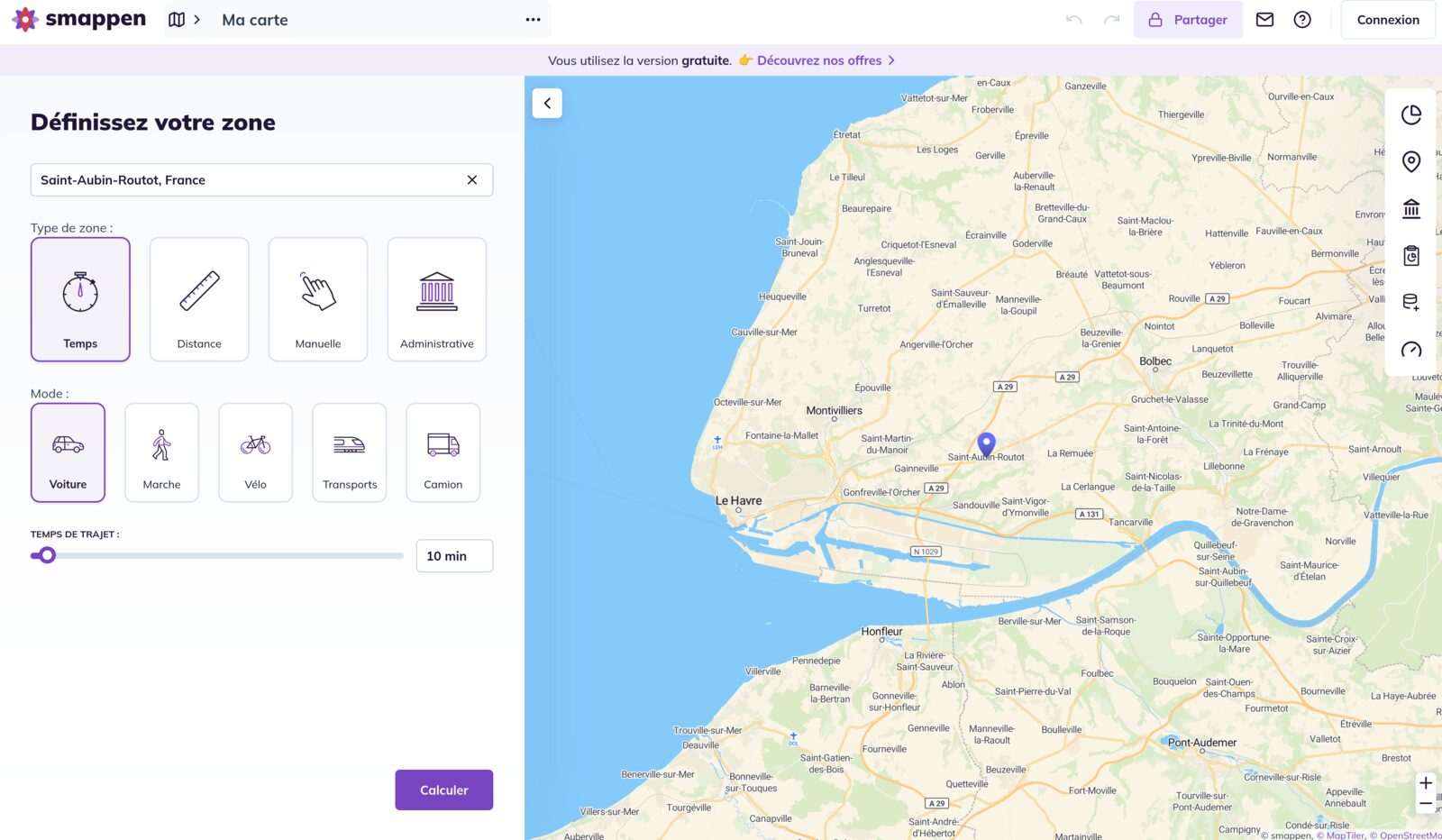
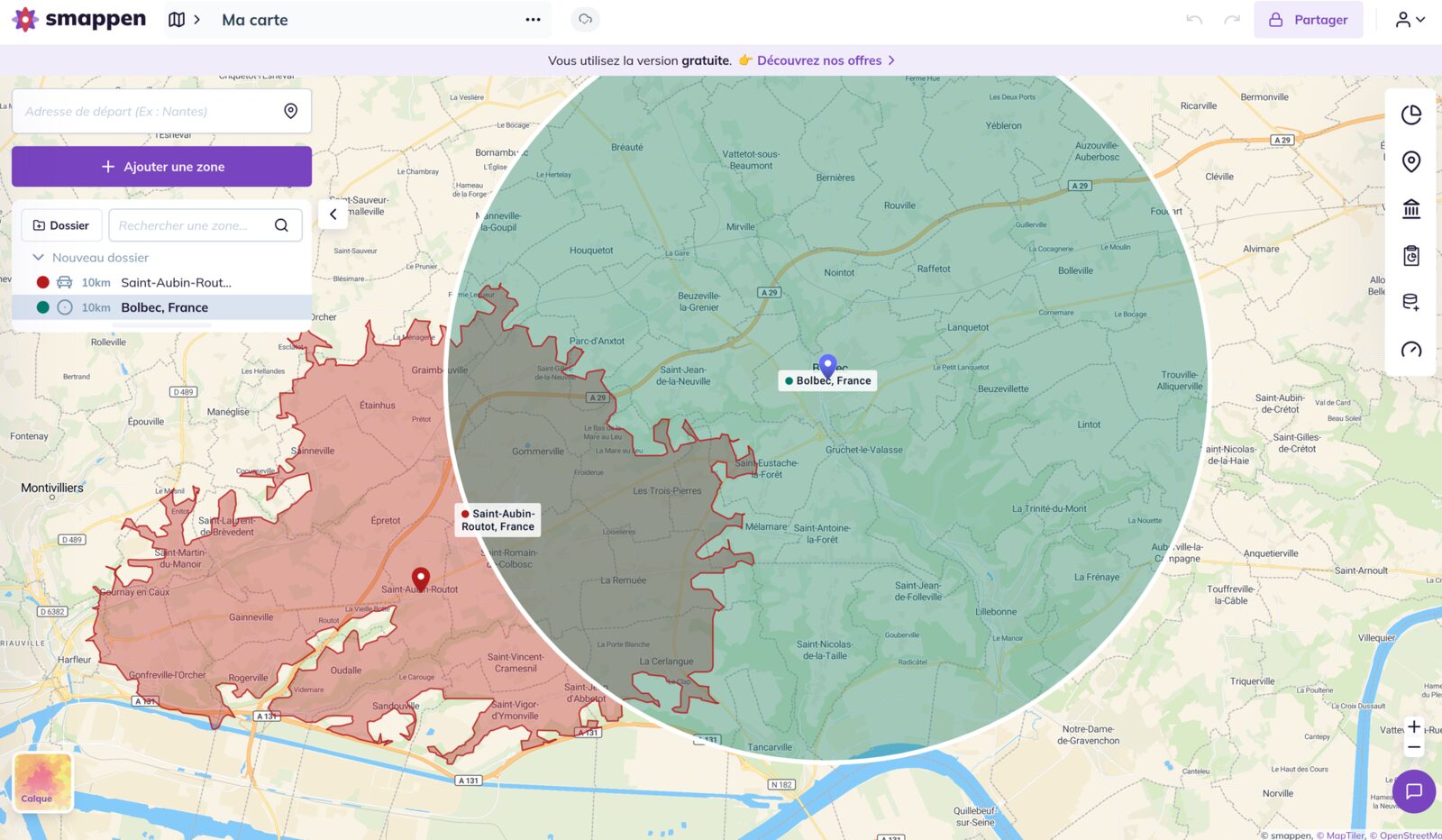
Our method: the description often gives clues like “10 minutes from the train station of X” or “5 minutes from village Y”. On smappen.fr (free) you can draw those zones: a 10-minute drive area around the station, a circle around the village. The house is somewhere in the intersection. Then you comb that area on Google Maps satellite view, comparing roofs, pools and garden shapes with the listing photos, and finish with Street View to confirm.
In all three cases, the agents asked the owners to take a walk or simply not be there during the visit. Much more comfortable: we could check things, touch, and ask any question.
One piece of advice: do not say everything is great and perfect during a visit. Make a point of finding some negative points and saying them out loud; they will be very useful when the time comes to negotiate.
The first house was amazing inside, but close to a road. Not a big one, an axis connecting two cities of the region: at rush hour, the garden was noisy.
The second one was really good, but some bedrooms were tiny, actually too small to legally count as bedrooms (under 9 m²). The house is beautiful and the garden is big enough (2,000 m²), but the energy rating (DPE) is F, all-electric with two pellet stoves: the promise of an expensive bill.
Agents know surprisingly little about the house
We found that real estate agents had very little knowledge about the houses: technical details, sometimes even simple details or the surroundings. And sometimes they hide the truth.
One of the houses had a whole part that was an extension: you could see it on Street View, with a lighter roof color on the extended part, and while walking around the outside there was a crack in the wall right where the extension joins (my father-in-law spotted it). The agent had no idea the house even had an extension.
For another house, we asked the agent why the owners were selling. Looking quite embarrassed, she answered that they had “a new professional project”. Very blurry. In the end we found out the real reason: a divorce. That changes quite a few things: a divorce often means a bigger hurry to sell (both need the money to buy their own place), so there is room to negotiate.
What to check during a visit
Our checklist, with the French terms in parentheses, because on site the French word is the one you will need:
- The energy rating (DPE)
- The heaters (radiateurs): are they old? Especially if electric
- Ask for the electricity bills (factures d’électricité) if possible, a must if the heating is all-electric
- The hot water tank (ballon d’eau chaude): what size, and when was it replaced?
- The electrical panel (tableau électrique): does it look new? Up to standard? There is usually an audit report to ask for
- Asbestos (amiante) in old building materials, and lead (plomb) in pre-1949 paint: for both, the seller must provide diagnostics
- The roof (toiture): missing tiles, moss
- The chimneys: maintained and swept recently (ramonage)?
- Humidity in the walls (humidité)
- Double glazing (double vitrage): expensive to replace well, and it helps a lot in winter
The most important one: the sewage system (assainissement)
First, when to worry: for a house in the countryside, a little out of the village center, an individual system is very likely. If the house is close to the village center, it may be connected to the public sewage (tout-à-l’égout), in which case there is no construction work to do at all.
If the house is not connected to the public sewer, it has an individual system (assainissement non collectif), usually a septic tank (fosse septique). Standards changed a lot in the past 30 years: if the house is old and did not change owners much, there is a big chance it is not up to standards. The reasons vary: the tank is too small for the size of the house (standards changed), or the system is not environment friendly (some old ones throw waste water almost directly into nature without proper filtering, soakaways called puisards, smells, and so on).
The seller does not have to bring it up to standard, but must provide an inspection report less than 3 years old (issued by the public service called SPANC), and the buyer has one year after the purchase to do the works. For a big house the bill can be huge: replacing the tank in the garden, digging, new pipes. More than 10,000€ is common.
And if you just ignore it? Legally, the commune can raise your sanitation charge (redevance) by up to 400%, which can mean several hundred euros per year (details here), but how strictly this is enforced varies a lot from one commune to another. Agents kept telling us: as long as there is no smell and no leak, no rush. They might not be totally wrong on that one.
The third one is beautiful, renovated, good DPE, a great field. But that story deserves its own chapter 😉
Leave a Reply