
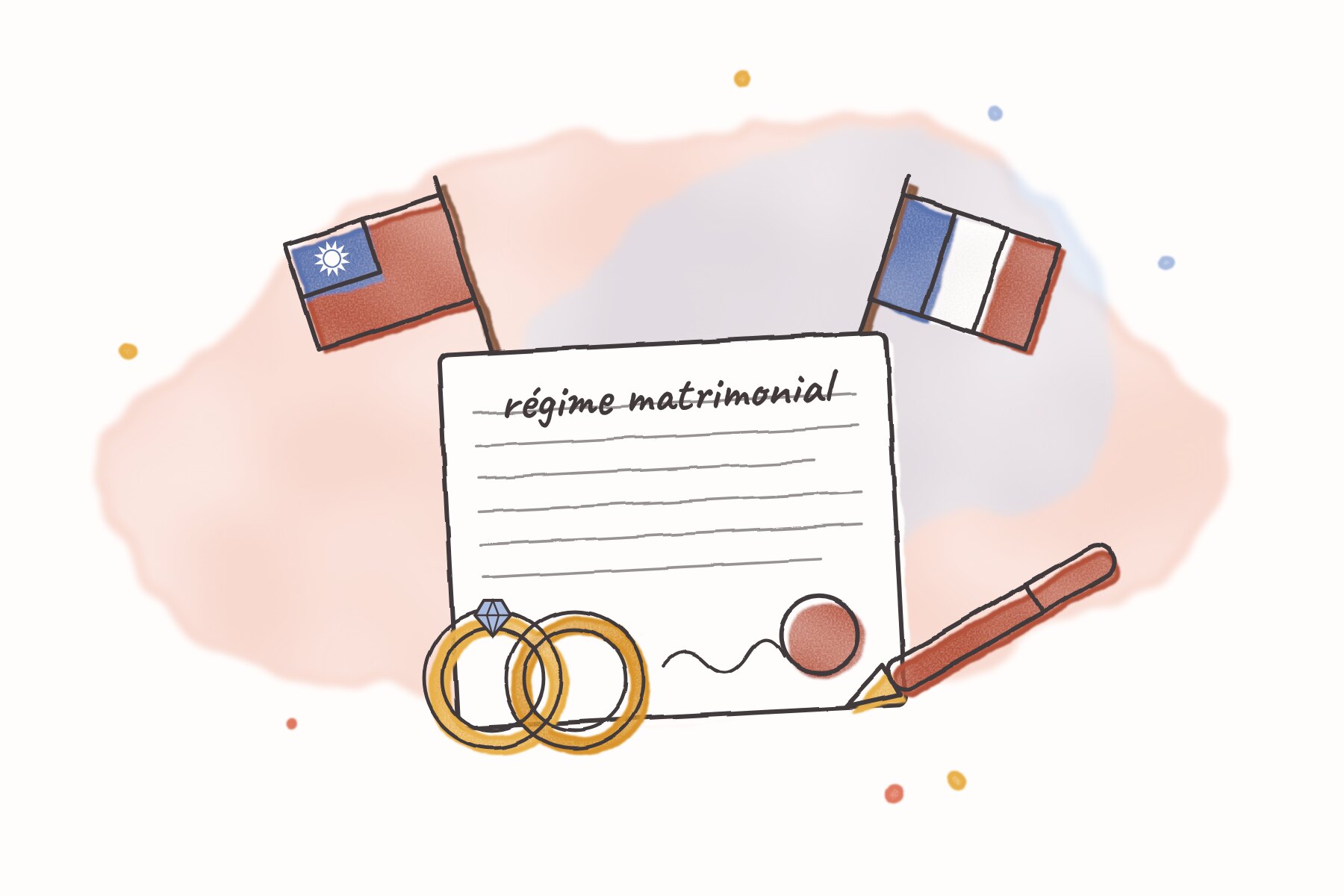
Buying a house in France means meeting a notaire, and a notaire means questions you never thought about. One of ours: “What is your matrimonial regime (régime matrimonial)?” Easy for most couples. For us, married in Taiwan and transcribed in France, it turned into a small legal puzzle.
The short answer
- No, a marriage contract (contrat de mariage) is not required to buy a house in France.
- But the notaire has to write your regime in the promesse de vente (the pre-contract) and the acte de vente (the final deed), and the bank asks about it too.
- Married in two countries without a contract? Your regime can be unclear. Our notaire’s fix: one extra acte notarié to settle it for good. Our price in 2026: 485 €, tax included.
Why the notaire needs your regime
The regime decides who owns the house, in what share, and what happens to it in case of divorce or death. So it is written in the promesse de vente and in the acte de vente. The bank asked about it as well, but never asked for proof (except maybe our livret de famille).
Married in two countries, no contract: two default regimes
We got married in Taiwan (the full story is here), then had the marriage transcribed into the French civil registry. We never signed a marriage contract, in either country. So we fall under the default regime… but which country’s default?
From far away the two look similar. Up close, not quite:
| France default | Taiwan default | |
|---|---|---|
| Name | Communauté réduite aux acquêts | Statutory regime (法定財產制) |
| Bought or earned during the marriage | Belongs to both of you, 50/50 | Belongs to the spouse who bought it, who also manages it |
| Owned before the marriage | Stays personal (biens propres) | Stays personal |
| Gifts and inheritances | Stay personal, even if received during the marriage | Stay personal, left out of the final split |
| Divorce or death | The common property is split in half | The spouse who gained less during the marriage can claim half of the difference (剩餘財產分配) |
Same spirit (what you build together gets shared), different mechanics: who owns the house during the marriage, who can sell it, how the split is calculated. Not the kind of detail you want to discover during a divorce or an inheritance.
The French rule, and our six-month gray zone
When a couple never chose, the rule in France says the regime follows the law of the couple’s first common habitual residence after the wedding.
After the wedding, we stayed about six months in Taiwan before moving to France. Is that enough to make Taiwan our first habitual residence? The text gives no minimum duration: it is judged case by case, on the facts.
Our notaire did his research and could not be sure. And more importantly, he could not promise that a judge, a lawyer or another notaire would read it the same way in 20 years, in case of divorce or if one of us passes away.
Six months in Taiwan after the wedding: enough to count as our first home? The law doesn’t say. Our notaire couldn’t either.
The fix: one acte notarié to choose
His advice: sign an acte notarié in which we choose the law of our marriage ourselves (désignation de la loi applicable). We chose French law, so the French default regime, the communauté réduite aux acquêts. No more guessing.
In the same acte, you decide whether the choice applies only from now on, or also back to the wedding day (rétroactif). We chose retroactive: one single regime for our whole marriage, much simpler if anyone ever has to look into it. Good to know: a retroactive choice cannot hurt the rights that other people (a creditor, for example) already had.
How it went, in order
| When | What happened |
|---|---|
| Promesse de vente | The notaire raises the question. We sign the promesse with the default regime written in |
| A few weeks later | We sign the acte notarié: French law, retroactive to our wedding day |
| A few weeks after that | Acte de vente |
| In the background | The notaire sends it to the central civil registry in Nantes. It will be noted in the margin (mention en marge) of our French marriage record and of my husband’s birth certificate |
Nantes does not have to finish before the acte de vente: the acte notarié itself is the proof, and that is enough for the sale.
On the Taiwan side: nothing to do. Would Taiwan recognize this French acte if it ever mattered there? Honestly, we don’t know.
The price
The notaire first announced more than 600 €, then came down to 485 € tax included (2026). Most of it is taxes: he told us he makes almost nothing on it, and since he was already handling our purchase, he agreed to do it nearly for free. Expensive for one signature… but cheaper than a legal fight in 20 years 😅
The communauté réduite aux acquêts, in real life
People often sum it up as “everything is 50/50”. Not exactly:
- Common, 50/50: everything earned or bought during the marriage, salaries included. Our house is common, whoever’s bank account the money came from.
- Personal (biens propres): everything each of us owned before the wedding.
- Also personal: gifts and inheritances, even received during the marriage. A donation from my parents stays mine.
One consequence: if one of you puts personal money into the house (savings from before the wedding, a family donation), tell the notaire before the acte de vente. He can write it into the acte, so that this money can be counted back later instead of quietly becoming common.
Our tips
- Married abroad, or in two countries, without a contract? Tell your notaire at the very first contact, before the promesse de vente.
- If an acte is needed, budget around 500 € (our 2026 price, tax included), and ask for a discount if the same notaire handles your purchase.
- Think about the retroactive option: one regime for the whole marriage is much easier to explain later.
- Not married yet? Talk to a notaire before the wedding: choosing your law from day one avoids all of this.
- Putting family money or pre-wedding savings into the house? Tell the notaire before the acte de vente.
We are not lawyers, this is just our experience: every couple is different, so check your own case with your notaire. And if you missed the beginning of our house story, it starts here.
Leave a Reply